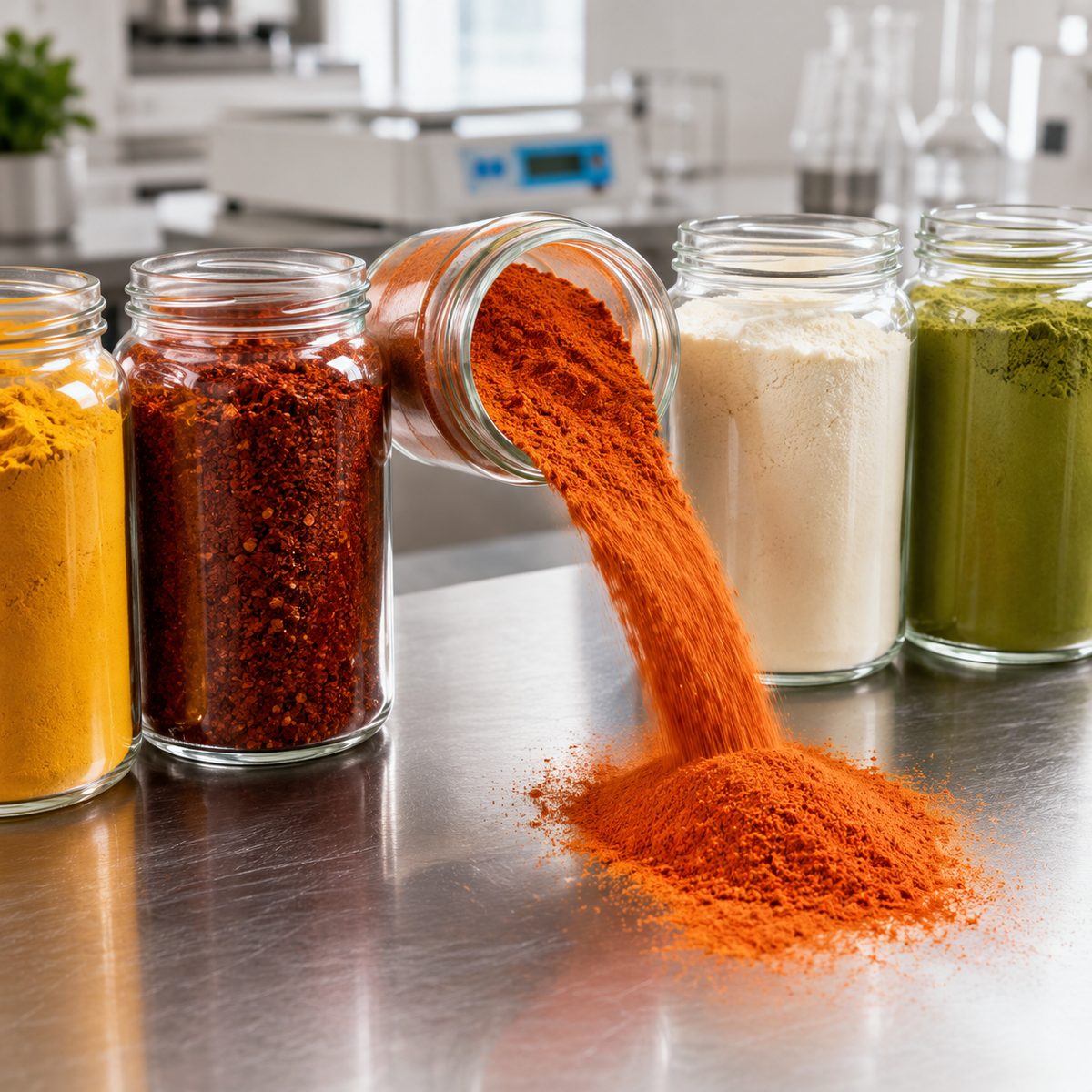
Built for food dry-mix, powder compounding, post-spray-drying and filling operations. Through porous-silica and precipitated-silica routes we improve how a powder flows from raw-material blending to packaging and storage — judged in your own formulation, not on a spec sheet.
Grades our customers usually benchmark against: Evonik food-grade SIPERNAT® 22, SIPERNAT® 45 / 45 S, W. R. Grace SYLOID® food-grade anti-caking and carrier silicas, and QEMETICA / PQ Flo-Gard™ AB and T-800.
Our route is not a brand-premium play: we start where the production problem is, run profile-matched screening, and earn the slot as a qualified second source — one validated sample at a time.
Three grades are put forward for this track. We do not publish typical-value tables here: the controlled TDS, COA and SDS for each grade are sent with the sample so that your evaluation runs on the document that will govern supply, not on brochure figures.
| Grade | Material | Where it sits in the screening |
|---|---|---|
| CENSIL 310 | Porous silica-based material | Moderate-surface porous route for food powders, toothpaste cleaning duty and flavour carriers. The general-purpose choice when structure and adsorption both matter. |
| CENSIL 320 | Porous silica-based material | High-surface porous grade. Used in food and oral-care structure work, and the preferred base substrate for functionalised fluoride-adsorbent screening. |
| CENSIL 260P | Precipitated silica powder | Base carrier. Start here when the liquid load is moderate and the real problem is flow and caking rather than raw absorption capacity. |
On data. Final performance, compliance and application fit follow the supplier's latest TDS, the lot COA and your own test results. Ask for the grade-specific document set before you commit a formulation or a trial protocol.
| Validation dimension | Signal to check | What it tells you |
|---|---|---|
| Storage caking | Hard lumps or agglomerates after moisture pickup | Shelf stability |
| Flow and discharge | Bridging, blockage and dosing variation | Line efficiency |
| Dispersion and segregation | Whether recipe uniformity holds through handling | Batch consistency |
| Filling | Packing speed and weight stability | The real value of switching |
| Lab-to-pilot consistency | Whether bench results survive the first pilot run | Scale-up risk |
“Food-powder silica cannot be chosen on price alone. What matters is how it performs in the real formulation — on flow, dispersion, dosing and storage stability together.”