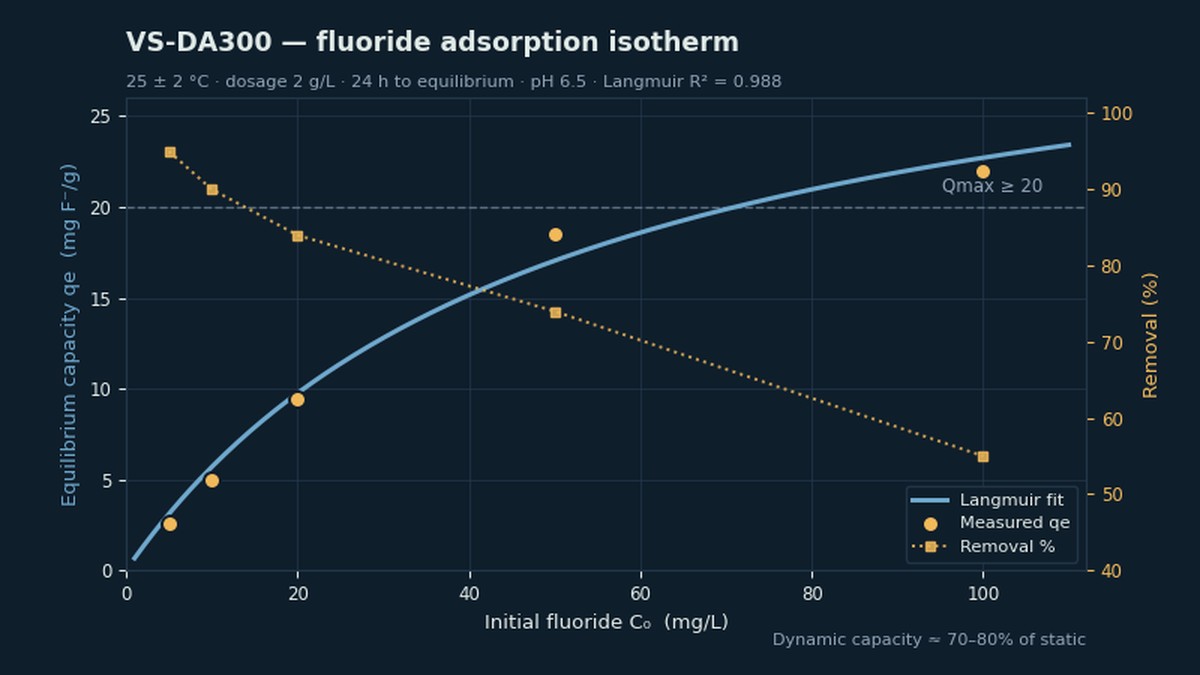
For deep treatment and end-of-line polishing of industrial fluoride-bearing wastewater. At this stage CENSIL 320, 310 and 500 serve as candidate porous-silica substrates for aluminium-, iron- or composite-modified adsorbent programmes. They are not offered as a finished, validated fluoride adsorbent — whether a route can be adopted is decided by jar tests and dynamic column trials on your own water.
Three grades are put forward for this track. We do not publish typical-value tables here: the controlled TDS, COA and SDS for each grade are sent with the sample so that your evaluation runs on the document that will govern supply, not on brochure figures.
| Grade | Material | Where it sits in the screening |
|---|---|---|
| CENSIL 320 | Porous silica-based material | High-surface porous grade. Used in food and oral-care structure work, and the preferred base substrate for functionalised fluoride-adsorbent screening. |
| CENSIL 310 | Porous silica-based material | Moderate-surface porous route for food powders, toothpaste cleaning duty and flavour carriers. The general-purpose choice when structure and adsorption both matter. |
| CENSIL 500 | High pore-volume silica | Supplied as a coating matting grade; used on the fluoride track as a high pore-volume comparison substrate when a screening programme needs a contrast material. |
On data. Final performance, compliance and application fit follow the supplier's latest TDS, the lot COA and your own test results. Ask for the grade-specific document set before you commit a formulation or a trial protocol.
A fluoride short list rarely contains another silica medium — it contains activated alumina, calcium precipitation up front, strong-base resin or a membrane. That is the honest comparison set, and it is the one we ask you to run the substrate screening against.
| Route | Verifiable representative products | Where customers use it | What Censil Silica checks against |
|---|---|---|---|
| Activated alumina | DI-tech / Weco Filters AAL-1CUFT; Tramfloc Activated Alumina; Actas® / Bee Chems Activated Alumina | Granular media for fluoride and arsenic beds — fixed, fluidised or cartridge | Compare working capacity, pH window, competing-ion sensitivity, media burn rate and total cost — not tonne price |
| Calcium precipitation + coagulation | Lime / calcium hydroxide, calcium chloride — dosed per project, no branded grade | Knocks the bulk fluoride load out of high-concentration streams | Not a replacement. It stays; a silica-based adsorbent is positioned downstream for the polish |
| Anion-exchange resin | Strong-base anion routes; resin follows the incumbent brand and regeneration setup | Deep treatment at low inlet concentrations | Weigh regenerant chemistry and volume, competing anions and spent-brine cost |
| RO / NF membranes | Industrial RO / NF trains — evaluated as systems, not as media | When several dissolved salts must go at once | Assess concentrate disposal, energy and hybrid-train feasibility |
| Validation dimension | Signal to check | What it tells you |
|---|---|---|
| Effluent fluoride & removal | Inlet vs. outlet fluoride across the inlet range you actually see | Whether the discharge target is reachable |
| pH, alkalinity and competing ions | Sulphate, chloride, phosphate and bicarbonate effects | Real-wastewater fit |
| Dynamic working capacity | Breakthrough point, bed volumes treated, change-out cycle | Project economics |
| Pressure drop and particle strength | Attrition, fines, blinding and pressure rise | Whether it survives plant-scale operation |
| Active-component leaching | What the modified substrate releases into the effluent | EHS and compliance |
| Cost per m³ treated | Pre-treatment, media, regeneration or replacement, sludge and disposal | How the route stacks up against alumina, resin and membranes |
“Water sample, front-end process and target effluent first — then we judge whether a CENSIL candidate substrate can enter a functionalised screening programme. Whether it is adopted is decided by the jar test and the dynamic column trial, not by us on paper.”