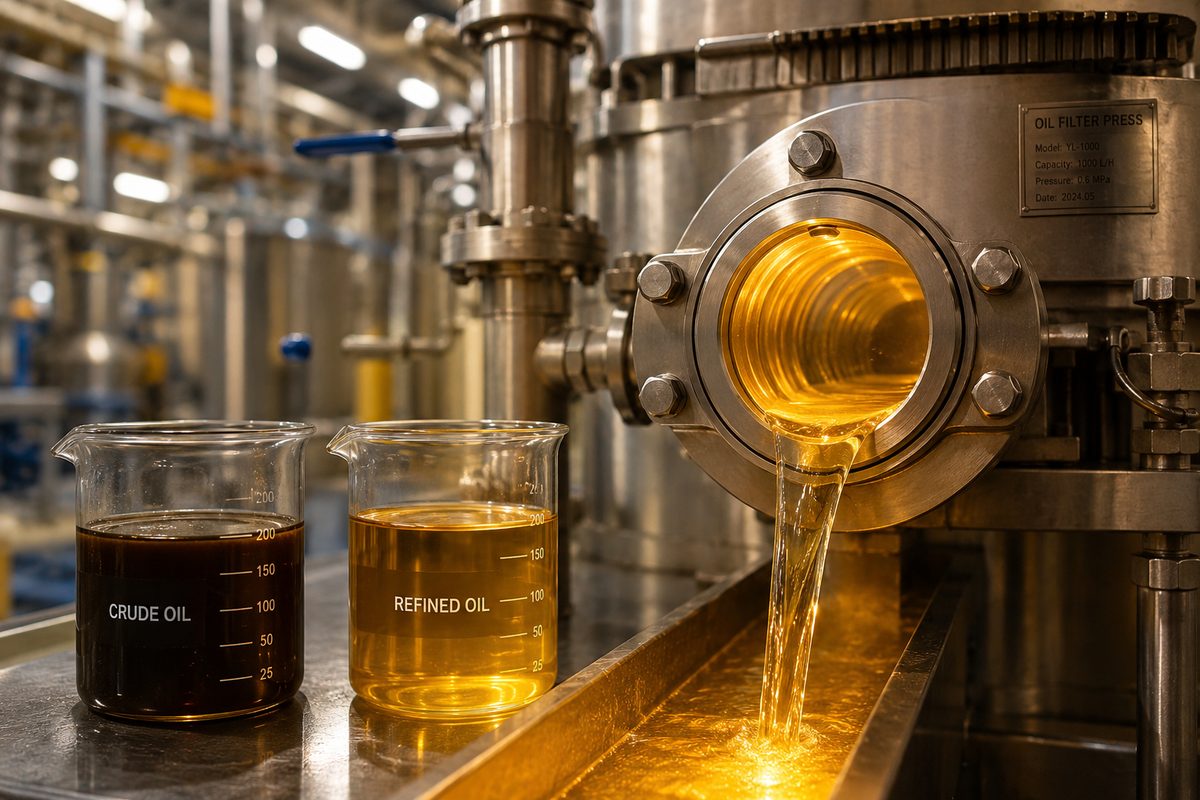
For independent refineries with real refining lines processing imported crude oil, focused on lowering residual phosphorus, filtration pressure drop and bleaching-earth consumption — a more cost-effective, stable refining combination.
On CS-OE550, a high BET surface area of 400–600 m²/g (ISO 9277) with oil absorption 180–260 g/100g supports phospholipid and soap adsorption in degumming and filtration.
Typical benchmarks: W. R. Grace TRISYL® series (dephosphorization / desoaping / filtration), PQ Sorbsil® oil pretreatment silica gel series, Fuji Silysia refining and adsorption silica gel series.
We don't replicate brand premiums. We enter through niche applications, second-source / backup supply and multiple grades, and differentiate with profile screening, problem diagnosis and sample conversion.
Censil Silica CS-series precipitated silica for this track is offered as CS-OE550 Adsorbent. Typical physical properties are shown below with the applicable test method for each parameter.
| Property | Unit | CS-OE550 Adsorbent | Test method |
|---|---|---|---|
| BET specific surface area | m²/g | 400 – 600 | ISO 9277 / DIN 66131 |
| Oil absorption (DOP) | g/100g | 180 – 260 | ISO 4652 / DIN 53617 |
| Particle size D50 | µm | 8 – 18 | ISO 13320 (laser diffraction) |
| Sieve residue (45 µm) | % | ≤ 1.0 | ISO 2591-1 |
| Bulk density (poured) | g/L | 350 – 500 | ISO 60 |
| Tapped density | g/L | 450 – 600 | ISO 697 |
| pH (5% aq. suspension) | — | 4.0 – 6.5 | ISO 6588 |
| Loss on drying (105 °C, 2 h) | % | ≤ 8.0 | ISO 787-2 |
| SiO₂ content (dry basis) | % | ≥ 98.0 | Gravimetric / XRF |
| Loss on ignition (1000 °C) | % | ≤ 10.0 | ISO 6798 |
Typical values. Typical values representative of the grade family. Values are for guidance; a grade-specific specification sheet is available on request.
| Test dimension | What to watch | What it tells the customer |
|---|---|---|
| Dephosphorization | Whether residual phosphorus is lowered | Judges refining effect |
| Soap residue | Whether desoaping quality improves | Judges product purity |
| Filtration pressure drop | Whether the filtration burden is reduced | Judges production efficiency |
| Bleaching-earth use | Whether earth use and overall cost fall | Judges economics |