Solution 06

Functionalised Silica-Based Fluoride Adsorbent Solution

For industrial fluoride-bearing wastewater — polishing after precipitation, deep removal ahead of discharge limits, and adsorption units inside water-treatment projects. We supply material, data, screening and test support; engineering design and final discharge compliance stay with you or your local licensed partner.

Cut the fluoride load first — then hold the polish stage steady.
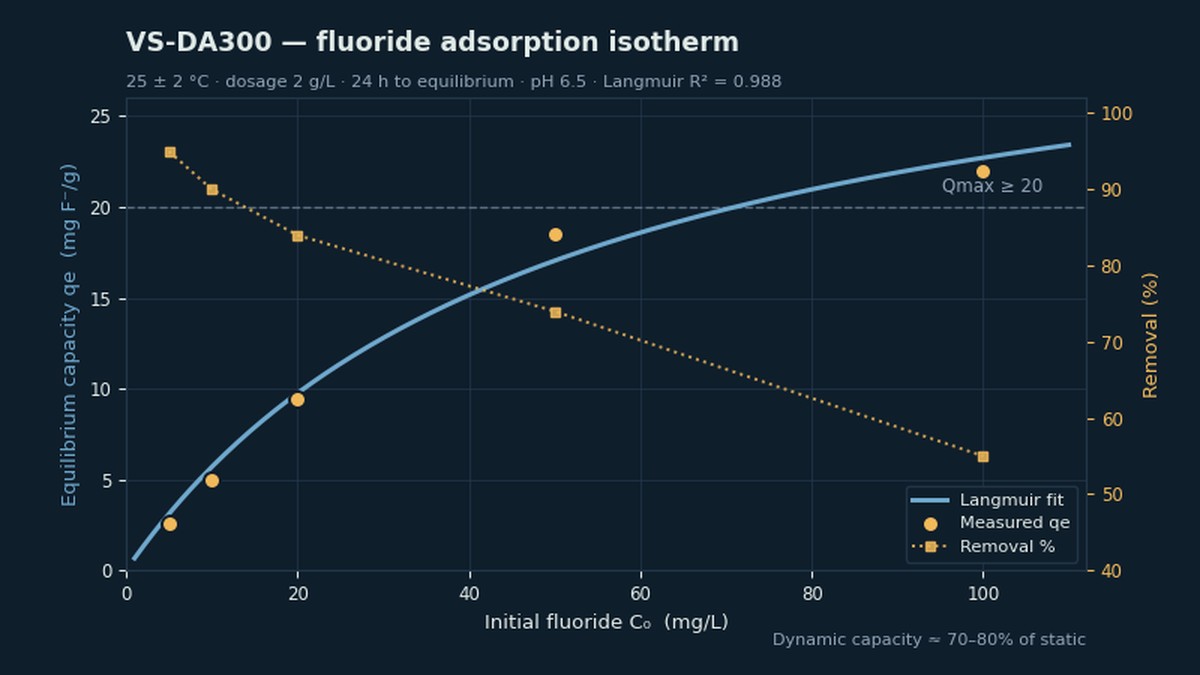
CS-DA300 fluoride adsorption isotherm — equilibrium capacity and removal rate against initial fluoride concentration, measured at 25 °C, 2 g/L dosage, pH 6.5
Measured adsorption isotherm for CS-DA300. Capacity climbs with inlet concentration while removal rate falls — which is precisely why this material belongs after front-end precipitation rather than instead of it. In the 5–20 mg/L window typical of a polishing stage, removal runs at 84–95%.
What this solution is — and is not

We do not sell ordinary precipitated silica as a universal defluoridation agent. Silica-based fluoride adsorbents described in the published literature are typically iron-modified, aluminium-modified or composite systems: the fluoride activity comes from the functionalised surface and its active components, not from food-grade silica itself. Material identity is confirmed against the supplier TDS, an active-component statement and real water-sample data before any project discussion.

Scope is industrial fluoride-bearing wastewater only — not drinking water, municipal supply or household point-of-use treatment.

Where it fits in the treatment train

For high-concentration fluoride wastewater, precipitation and coagulation are normally used first to bring the fluoride load down. Adsorption and ion-exchange routes are better suited to the stage that follows — deeper removal and end-of-line polishing. This solution is positioned at that second stage, not as a replacement for front-end precipitation.

Core value

  • Lower residual fluoride further after front-end precipitation or conventional treatment, reducing the risk of exceeding the discharge limit at the outfall.
  • Screen different functionalised silica-based materials against your water chemistry, pH, competing ions, target effluent and existing process.
  • Enter through samples, jar tests, column trials and project-based replenishment — suited to dispersed, small-batch demand with a high technical-service component.

Who it's for

  • EHS, water-treatment and production teams at semiconductor and electronic-chemical, electroplating and surface-finishing, photovoltaic, fluorochemical, metal-processing and phosphate-chemical plants.
  • Environmental engineering contractors, EPCs and industrial water-treatment integrators running fluoride projects.
  • Service providers operating adsorption columns, media loading or industrial wastewater stations.

CS-DA300 — grade data

Censil Silica offers this track as CS-DA300, an alumina-modified functionalised silica fluoride adsorbent. It is neither a granular activated alumina nor a food-grade white carbon black: the active aluminium species is supported on a precipitated silica framework, which is the structural reason its capacity sits above conventional activated alumina on a per-gram basis.

Active components

ComponentChemical formContentFunction
FrameworkPrecipitated silica, SiO₂·nH₂O≥ 70%High-surface-area support; disperses and anchors the active sites
Primary active componentSupported alumina / boehmite (Al₂O₃ / AlOOH)8–15% as Al₂O₃Surface hydroxyls exchange with F⁻ — the core adsorption site
ModifierAlkali metal oxide (Na₂O)≤ 0.5%Controls surface charge and pH buffering

Removal mechanism. Ligand exchange (Al–OH + F⁻ → Al–F) accounts for over 80% of uptake, with electrostatic adsorption and anion exchange as secondary contributions.

Physical and chemical properties

PropertyUnitCS-DA300
SiO₂ content (dry basis)%≥ 70
Al₂O₃ content (active component, dry basis)%8 – 15
Na₂O content%≤ 0.5
BET specific surface aream²/g250 – 350
Particle size (granular)mm0.5–1 / 1–3 (customisable; powder grade on request)
Bulk density (granular)g/cm³0.45 – 0.65
Crush strengthN/particle≥ 25 (1–3 mm)
Attrition rate%≤ 1.0
Water absorption%≥ 60
pH (5% aq. suspension)6.0 – 8.0
Loss on ignition (1000 °C)%≤ 10

Static adsorption capacity

Test conditions: 25 ± 2 °C, dosage 2 g/L, 24 h contact to equilibrium, pH 6.5.

Initial fluoride C₀ (mg/L)Equilibrium capacity qe (mg F⁻/g)Removal (%)
52.695
105.090
209.484
5018.574
10022.055

Saturated static capacity (Langmuir Qmax) ≥ 20 mg F⁻/g; Langmuir monolayer model, R² ≥ 0.95. Dynamic capacity runs at roughly 70–80% of the static figure — size your column on the dynamic number, not this table.

Operating window

ConditionBehaviour
Optimal pH5 – 7 — matches typical industrial polishing-stage conditions
Usable pH range4 – 8.5, retaining ≥ 80% of capacity
Above pH 9Capacity drops markedly; front-end pH adjustment recommended
SO₄²⁻ / Cl⁻ / NO₃⁻Minor effect
HCO₃⁻ / CO₃²⁻Competitive inhibition; high-alkalinity water needs pH pre-adjustment or a higher dosage
PO₄³⁻Strong competition; phosphate-bearing streams should be segregated or dephosphorised first

Regeneration and service life

Regeneration cycle: soak in 4% NaOH for 2–4 h → rinse to neutral → activate in 5% HCl for 1–2 h → rinse to neutral pH.

AfterCapacity retained
20 regeneration cycles≥ 85%
50 regeneration cycles≥ 75%
Typical replacement interval1–2 years, depending on water chemistry and throughput

Packaging and storage

20 / 25 kg paper sacks with PE liner, or 500 / 1000 kg bulk bags. Store sealed and dry at 5–30 °C, relative humidity ≤ 70%.

Reference standards

HG/T 3927 (general adsorbents), GB/T 22627-2014, GB 5749-2022 (effluent limit reference), REACH (EINECS 231-545-4, silicic acid).

Typical values. Figures above are representative of the grade. Performance on your effluent must be confirmed by jar test and dynamic column trial — a grade-specific specification sheet and COA are available on request.

Alternative routes you are probably comparing

Competition in fluoride removal is not mainly another silica-based adsorbent. The realistic alternatives are activated alumina, front-end calcium precipitation, anion-exchange resin and membranes. Functionalised silica-based fluoride media have not converged on globally standardised commercial grades the way oral-care silica has, so verifiable products and process routes are listed separately below rather than invented as like-for-like model numbers.

RouteVerifiable representative productsWhere customers use itWhat to compare
Activated aluminaDI-tech / Weco Filters AAL-1CUFT; Tramfloc Activated Alumina; Actas® / Bee Chems Activated AluminaGranular adsorbent media for fluoride and arsenic reduction; fixed bed, fluidised bed or cartridge formatsDynamic breakthrough capacity, pH tolerance, competing-ion effect, media consumption and total project cost — not price per tonne alone
Calcium precipitation + coagulationLime / calcium hydroxide, calcium chloride — project-specific dosing, no single global gradeFront-end load reduction on high-fluoride streams, forming calcium fluoride sludge for solid-liquid separationNot a route to displace. Functionalised silica adsorbent sits after it, for deep removal and polishing
Anion-exchange resinStrong-base anion resin routes; grade depends on the customer's current brand, feed salinity and regeneration systemLow-concentration deep treatment, or where effluent limits are tightSelectivity, regenerant consumption, competing-ion interference, spent regenerant handling and total operating cost
Reverse osmosis / membranesIndustrial RO / NF systems — benchmarked at system and element level, not as a single adsorbent gradeProjects removing multiple dissolved salts where the customer can handle the concentrateWhere membrane cost is high or concentrate disposal is difficult, adsorption can be the deep-treatment or hybrid option

Technical service

  • Water-chemistry review — confirm inlet and target fluoride, pH, alkalinity, hardness, sulphate, chloride, phosphate, bicarbonate, COD, flow rate and the existing treatment train.
  • Material screening — select active component, particle size and packing form against the water chemistry and target; comparison samples across routes where useful.
  • Static jar tests — evaluate dosage, contact time, pH effect and competing-ion interference.
  • Dynamic column trials — evaluate working capacity, breakthrough point, pressure drop, continuous-run stability and replacement interval.
  • Project supply — samples, trial orders, staged loading and project replenishment, with design and final responsibility held by the customer or their licensed local partner.

Validation guide

Test dimensionWhat to watchWhat it tells you
Fluoride removalEffluent fluoride and removal rate across inlet concentrationsWhether the target discharge limit is within reach
pH toleranceStability of performance across your operating pH windowWhether additional pH adjustment is needed
Competing ionsEffect of bicarbonate, sulphate, chloride, phosphate and organicsWhether it holds up in the real effluent, not just synthetic water
Dynamic breakthrough capacityThroughput before breakthrough, per unit mass of mediaReplacement frequency and project economics
Pressure drop & particle strengthWhether the media powders, blinds or builds pressure too quicklyWhether it is operable at plant scale
Material safety & disposalActive-component leaching, spent-media classification and disposal routeEHS and compliance cost
Cost per m³ treatedMedia, pre-treatment, regeneration or replacement, sludge and disposalEconomics against alumina, resin, membrane and precipitation routes

Related solutions & data

How we talk about this with customers

“This solution is not about replacing every fluoride-removal process with ordinary silica. For high-fluoride wastewater the load is normally cut by a front-end process first; what we bring is a functionalised silica-based adsorbent for deep removal after precipitation and for steady end-of-line control. We look at the water chemistry, the existing process and the target effluent first, then confirm fit through jar tests and dynamic column trials.”

Have a fluoride-bearing effluent to bring down?Send the inlet and target fluoride, pH, competing ions, flow rate and your existing treatment train — we will tell you whether an adsorption stage makes sense before anything is sampled.
Talk to an expert
← All solutions Next: Feed Additive Flow & Carrier →