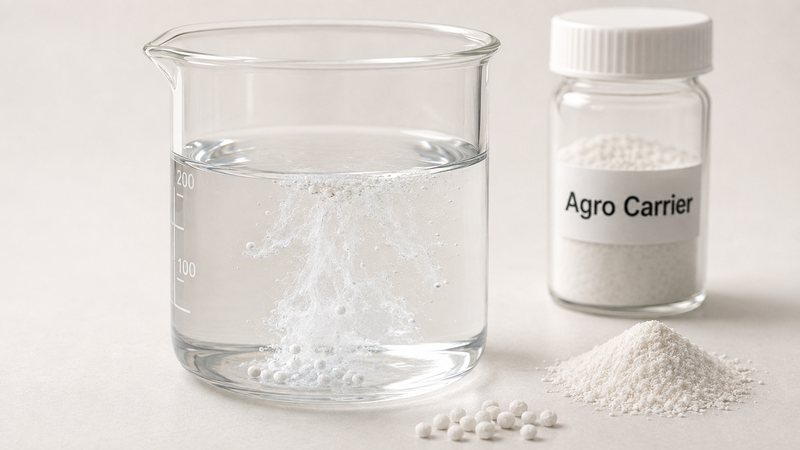
We supply a physically inert material to licensed local formulators, and nothing more than that: registration, label claims and efficacy are the formulator's territory, never ours. What we can be measured on is absorption of the active and its adjuvants, how a granule disintegrates and disperses, how an SC resists settling and pour-out residue, and how the powder behaves for dust and flow in the plant. For WP and WG the choice starts at DBP absorption (ISO 4652); SC support starts from structure.
The compliance boundary comes first
Our customers in this track are licensed formulators who already hold the registrations for the products they blend. Censil Silica supplies an inert mineral that carries, disperses or structures — it does not contribute biological activity, and we make no statement about the performance of the finished pesticide. Registration dossiers, label claims and field efficacy sit entirely with the formulator. Everything below is about physical behaviour on the plant floor and in the spray tank.
Three dosage forms, three different demands on the same powder
In a wettable powder the carrier dilutes and holds the technical active along with whatever adjuvants come with it, then has to wet out the moment it hits water. Absorption capacity is what governs the choice, since the powder must take the liquid load without turning tacky in the blender or on the bagging line.
Granules reverse the emphasis. Absorption still has to be there, but now the compacted granule is required to come apart within seconds in the tank and disperse cleanly. Absorb strongly, pack densely, and you get a granule that survives handling beautifully and then overshoots the disintegration specification. Strength and breakup pull against each other, and the carrier is the piece sitting between them.
An SC calls on silica for something else entirely. The active is already suspended as a solid in a liquid phase, so there is no carrying to do. The silica holds a weak network that keeps the suspended solids from sedimenting into a cake and leaving residue behind when the drum is poured out — rheology, not absorption.
When disintegration fails, look at packing before you look at binder
Most disintegration failures we are asked to look at turn out to be a packing problem. Leave void structure in the granule — a coarser distribution at moderate tapped density — and water climbs in by capillary action and splits the granule from within. Choose a very fine carrier that packs tightly and those pathways close; the granule can then only be worn away from the outside, which takes far longer than the specification allows.
Oversize is a separate matter and shows up in a different place. Coarse particles pass through granulation unchanged and remain as hard cores once the matrix around them has dispersed, ending up as residue on the spray-tank filter. A moderately coarse D50 (ISO 13320) with the 45 µm sieve residue held down (ISO 2591-1) keeps enough voids for fast capillary breakup and still keeps the coarse tail small enough that filters stay clear.
CENSIL 265P — the parameters a formulator actually screens
| Parameter | Method | What it decides on the line |
|---|---|---|
| Oil absorption (DBP) | ISO 4652 / DIN 53617 | How much active plus adjuvant the powder will take before going tacky |
| Particle size D50 | ISO 13320 | Void structure inside the granule, hence how fast it breaks and disperses |
| BET specific surface area | ISO 9277 / DIN 66131 | Uptake of liquid active and of surfactant drawn from the formulation |
| Tapped density | ISO 697 | Granule packing, water-entry pathways, and dust and flow when handled |
| Sieve residue (45 µm) | ISO 2591-1 | The coarse tail that survives to block a spray-tank filter |
| pH (5% aq. suspension) | ISO 6588 | Near-neutral, which matters where the active hydrolyses easily |
| Loss on drying (105 °C, 2 h) | ISO 787-2 | Water the carrier brings with it into a moisture-sensitive blend |
Values. The figures for each property are on the grade's controlled TDS, which is sent with the sample; we do not publish typical-value tables on this site.
How we work through a carrier selection
Let the dosage form set the question, not the active
Absorption opens the discussion for a WP, the absorption-against-disintegration balance opens it for a WG, and rheology opens it for an SC. The same active running on two different lines does not mean the WP carrier walks across to the granulator.
WP: size the carrier from the liquid load it has to take
Take the liquid fraction of the technical active plus adjuvants, divide by the oil absorption figure, and you have a floor for carrier level. Then prove the powder out on wettability and suspensibility by CIPAC method — a look and a squeeze in the hand is not a result.
WG: let disintegration be the constraint everything else fits around
Lock the disintegration and dispersion specification, pick the carrier that clears it, and only then tune binder and active loading inside that envelope. Adding binder because granules are too friable will, almost every time, push breakup time the wrong way.
SC: select on structure, then verify the active tolerates the powder
Resistance to settling and to pour-out residue comes from the weak network the silica holds in the continuous phase. Check that the grade's pH (ISO 6588) and residual moisture (ISO 787-2) suit the active, since hydrolysis-prone actives are where these systems usually come apart.
Judge on stored samples, and check dust and flow while you are there
Put disintegration and suspension stability through accelerated storage at elevated temperature before you sign anything; both drift with age, and a fresh sample passes where a 14-day sample will not. Handling behaviour in the plant — dusting at the bag tip, flow through the hopper — deserves the same look.
Frequently asked questions
Does a carrier qualified on a WP line transfer to a WG line?
Not without re-testing. A wettable powder is largely an absorption question: hold the active and the adjuvants without the powder turning tacky. A granule adds a second and competing requirement, because the same loading still has to fall apart in the spray tank. Particle size and packing density therefore move from secondary data to primary acceptance criteria.
Our WG keeps failing disintegration — is the binder to blame?
Usually not. In most plants the carrier's packing behaviour has closed off the interstitial voids that let water in by capillary action, so the granule can only erode slowly from its outer surface. A carrier that preserves void structure — coarser D50, moderate tapped density — restores capillary breakup, and it does so without adding binder.
Does silica act as a carrier inside a suspension concentrate?
No. In an SC the active is already dispersed through the liquid, so there is nothing left to carry. Silica is there to hold a weak structure that stops the solids settling into a hard cake and leaving residue in the drum at pour-out. Rheological contribution and compatibility with the active are the starting point, not absorption capacity.
Related: Agrochemical solution overview · Full grade specifications · All articles