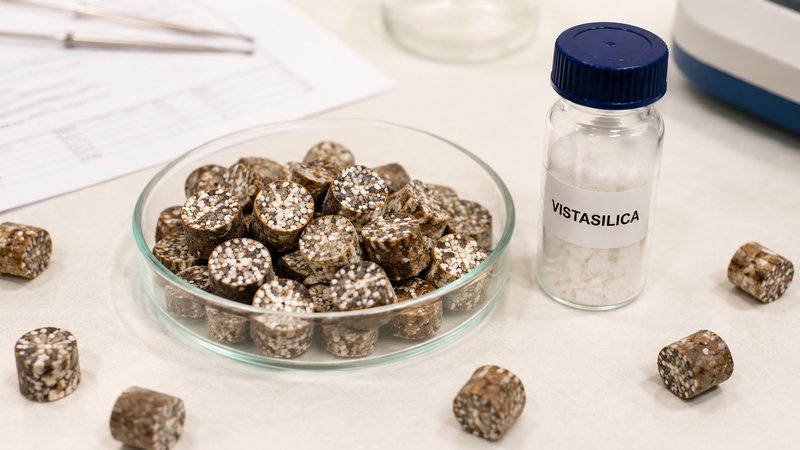
Powdering a liquid additive is a capillary problem: the pore network of a precipitated silica holds the liquid inside the particle while the bulk still pours. How much of the carrier's own mass can be held this way is set by its DBP absorption (ISO 4652) — a figure that lives on the grade's TDS, not in a brochure. Holding liquid and stopping caking, however, are two different duties, and one grade seldom does both at sensible cost.
Two duties that pull the specification apart
Start with the process problem rather than the product sheet. When choline chloride solution, an organic-acid blend, a tocopherol antioxidant or a propionate-based mould inhibitor has to leave the plant as a powder, what matters is internal pore volume — capillary forces draw the liquid inside the particle and lock it there. Caking is the opposite geometry. There, fine silica sits on the outside of the host grains, keeps them from touching, and breaks the bridges that form wherever moisture condenses at a contact point.
Because one duty works inward and the other outward, the ideal specifications diverge. High absorption capacity comes with pore volume and a comparatively coarse, open particle. Effective anti-caking wants the opposite: fine, light material that spreads over a large host area at a small mass fraction. Force a single grade to cover both and it will under-perform at one end, which is the usual reason a premix line is quietly running twice the dosage it needs.
The mixer says fine, the silo says otherwise
Caking needs time and load, and a mixer offers neither. Blend leaving the mixer is aerated, warm and pours beautifully — which tells you almost nothing. Weeks into silo storage the bed is compressed by its own head, moisture is drifting toward the cooler wall, and hygroscopic components (choline chloride above all, plus trace-mineral sulphates) are dissolving and recrystallising at every grain-to-grain contact. Those crystalline necks are the arch that eventually stalls the dispensing line.
Two numbers indicate how well a silica resists that sequence. A low tapped density (ISO 697) says the coating layer will not collapse under head pressure the way a dense filler does. Loss on drying (ISO 787-2) says how much water the additive itself brings into a system that is already moisture-sensitive. Neither shows up in a flow check run the same afternoon; both show up in a 4-6 week trial stored under realistic load.
CENSIL 280P — the TDS figures that decide liquid load and premix behaviour
| Property | Test method | What it tells you on the premix line |
|---|---|---|
| Oil absorption (DBP) | ISO 4652 / DIN 53617 | Where the ceiling sits before the blend goes tacky |
| BET specific surface area | ISO 9277 / DIN 66131 | How readily polar liquids and mineral solutions are taken up |
| Particle size D50 | ISO 13320 | Low dusting at the intake, still uniform through the mixer |
| Tapped density | ISO 697 | How far the bed will consolidate under its own head |
| Loss on drying (105 °C, 2 h) | ISO 787-2 | Water the carrier itself adds to a moisture-sensitive blend |
| Sieve residue (45 µm) | ISO 2591-1 | Oversize that tends to segregate during handling |
| SiO₂ content (dry basis) | Gravimetric / XRF | Inert body of the material; the rest is bound water and trace oxides |
Values. The figures for each property are on the grade's controlled TDS, which is sent with the sample; we do not publish typical-value tables on this site.
How we work through a selection
Name the duty first, then look at grades
Is the brief to powder a liquid, to stop a dry blend from setting solid in storage, or both at once? Powdering starts at absorption capacity; arching in the silo starts at tapped density and fineness. Collapsing the two questions into one grade choice is where most over-dosing begins.
Derive the carrier ratio arithmetically
Take the liquid percentage you actually need to load, divide by the absorption figure, then leave headroom for process variation. The absorption figure on the grade's TDS sets the ceiling, but viscosity and polarity move it, so the number is a hypothesis until the real additive has been run on the real material.
Look at what the host powder is made of
Hygroscopic chlorides, sulphates and organic acids are the components that recrystallise into bridges. Where they dominate the recipe, the answer is a finer flow aid that achieves continuous coverage at a low addition rate — not a bigger scoop of something coarse.
Prove it with a ladder, not a single point
Run liquid load in steps and measure at every rung: flow of the fresh powder, blend uniformity across the mixer, dosing repeatability at the feeder, and caking after 4-6 weeks at representative fill height and humidity. Week-one results routinely disagree with week-five results.
Step the dosage down until something breaks
Begin at whatever the plant uses today and reduce in fixed increments over successive runs until performance moves. Incumbent dosages survive for years simply because nobody has ever run the descending series.
Field case — Germany
System: Premix, bulk silo storage · Grade: CENSIL 260P
Problem. Even at a 2.0% addition rate of the existing flow aid, the premix was setting up after six weeks in the silo — roughly four hours a month lost on the dispensing line.
Action. We put a low-tapped-density, high-porosity silica through three production runs across 90 days at less than half the incumbent rate, 0.8%.
Result.
- Addition rate cut from 2.0% down to 0.8%
- Twelve months of follow-up with zero caking events logged
- 18% off the annual silica spend
- OEE on the dispensing line up from 92% to 97%
Frequently asked questions
How do I work out the carrier ratio when powdering a liquid feed additive?
Work backwards from absorption capacity. Take the DBP absorption on the grade's TDS (ISO 4652), leave headroom for process variation, and derive the carrier ratio from the liquid percentage you actually need to load. Thick or strongly polar additives such as choline chloride solutions sit nearer the low end, and the working ratio has to be fixed on the real liquid, not on the datasheet.
Is one grade enough for both carrying duty and anti-caking duty in a premix?
Technically yes, economically rarely. Absorption capacity wants pore volume and a coarser porous particle; anti-caking wants fineness and a low tapped density so a thin coating reaches the whole host surface. Where a plant forces one grade to do both, the dosage typically runs well above what a paired-grade approach needs to reach the same result.
The premix flowed well at the mixer, so why did it bridge in the silo?
Nothing that causes silo caking is present in a funnel test on fresh blend: bed pressure, moisture migrating along temperature gradients, and hygroscopic salts recrystallising at contact points all need weeks to act. Proof has to come from a 4-6 week storage trial at realistic fill height and humidity, with flow measured before and after.
Related: Feed additives solution overview · Full grade specifications · All articles