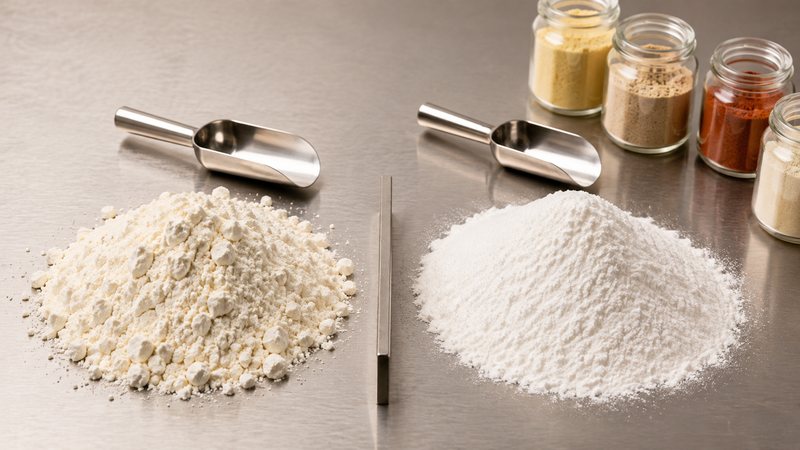
A flow aid is only as good as its behaviour inside your recipe. What decides the outcome is how much host surface a given mass of silica actually covers — and a fine particle-size cut (D50 by ISO 13320) covers far more than a coarse grade delivers. So the answer for a fine, hygroscopic or fat-bearing blend is usually a finer material, not a heavier addition of a coarse one.
Three ways a blend sets solid, only one of them is water
Caking is bridge formation between host grains, and humidity is only the most familiar route to it. Where soluble components — salt, sugar, acidulants — sit at a contact point, condensed moisture dissolves them and they recrystallise into a rigid neck. Where the recipe carries oleoresin, dairy powder or roasted spice, fat softens through its melting range and re-sets across the same contacts. And plate-like or needle-shaped particles simply interlock, with no chemistry involved at all.
What silica does is occupy those contact points. Fine particles anchor to the host surface and hold the grains apart, so a neck never has anywhere to form. That makes coverage the governing variable — how far a given mass can spread over the host, which follows from fineness and density rather than from the percentage written on the batch sheet.
Why a proven dosage does not travel between SKUs
Give two blends the same 0.5% and the results can be nothing alike, because their host surface areas can differ tenfold. Granulated seasoning around 300 µm presents a small fraction of the surface that a 40 µm milled spice does. One blend ends up generously coated; the other ends up patchy, with bare contacts left exposed.
Composition moves the target again. Recipes carrying oleoresin, cheese powder or nut solids ask the silica to bind free surface fat as well as act as a spacer, which pushes the useful absorption range upward. Salt- or acid-dominated systems, meanwhile, need the coverage to be unbroken — one uncovered contact is enough to start a bridge.
Treat a validated loading on one export SKU as a hypothesis for the next, then measure four things in the real formulation: caking after storage, flow out of the hopper, dispersion and segregation, and weight consistency at line speed.
CENSIL 310 — reading the figures against a real dry blend
| Property | Test method | What it decides in the formulation |
|---|---|---|
| Particle size D50 | ISO 13320 | How far one kilogram of silica spreads over the host |
| BET specific surface area | ISO 9277 / DIN 66131 | Working capacity for surface moisture and free oil |
| Oil absorption (DBP) | ISO 4652 / DIN 53617 | Headroom for fat in oleoresin- and dairy-bearing recipes |
| Tapped density | ISO 697 | How the powder holds up under pack and pallet load |
| Sieve residue (45 µm) | ISO 2591-1 | Oversize that would read as grit or specks on the tongue |
| Loss on drying (105 °C, 2 h) | ISO 787-2 | Water carried into an already hygroscopic recipe |
| pH (5% aq. suspension) | ISO 6588 | Close to neutral, so acidulants and colours stay unaffected |
Values. The figures for each property are on the grade's controlled TDS, which is sent with the sample; we do not publish typical-value tables on this site.
How we work through a selection
Find out which bridge you are fighting
Split the stress test: one sample held humid, another held warm. Blocking under humidity alone points at soluble recrystallisation, where unbroken coverage is what counts. Blocking under heat points at fat, and the controlling number shifts to absorption capacity. Many blends fail both ways, which is worth knowing before a grade is chosen.
Scale the dosage to the host, not to precedent
Compare host D50 and bulk density against a recipe where the loading is already proven. Halving the host particle size roughly doubles the surface needing cover — and the efficient answer to that is normally a finer flow aid, not a proportionally bigger addition.
Size the flow aid against the finest thing in the recipe
Bridges nucleate on the fine fraction, so that is what has to be covered. A fine D50 (ISO 13320) with a tightly held 45 µm sieve residue (ISO 2591-1) coats milled spice thoroughly and stays below the threshold where anyone detects grit.
Put treated and untreated side by side under destination conditions
Four weeks minimum, at the humidity and temperature the product will actually meet. Score storage caking, flow out of the hopper, dispersion on reconstitution, and weight scatter at production line speed. A free-flowing sample next to a blocked control is the evidence a distributor accepts.
Close the loop on sensory before rollout
Low addition rates and an inert material mean the risk is small, but small is not zero. Run a triangle test on the finished blend — especially where the aroma profile is the selling point — before the grade is written into every SKU.
Field case — Indonesia
System: Spice-blend sachets for humid export markets · Grade: CENSIL 310
Problem. Sachets going to Malaysia and the UAE were arriving caked, and distributor returns had reached about 3.2% of export volume.
Action. The three highest-volume export SKUs were reformulated with a food-grade anti-caking silica at 0.6%, then proved against untreated controls in a 40 °C / 75% RH chamber.
Result.
- Four weeks at 40 °C / 75% RH: treated material still pouring, control blocked solid
- Returns attributed to caking down from 3.2% to below 0.3%
- Triangle test at n = 60 found no perceptible taste or aroma shift
- Seven more export SKUs converted over the following year
Frequently asked questions
How much anti-caking silica should go into a seasoning blend?
There is no transferable number, because the requirement scales with the surface area of the host powder. A coarse granulated blend needs less coverage than a finely milled spice at the same level of protection. Published food applications generally sit under 2%, and each destination market sets its own regulatory ceiling for silicon dioxide as an anti-caking agent. Fix the working level on your own blend in a humidity chamber.
Will the anti-caking agent change how a seasoning tastes or smells?
In practice, no: precipitated silica is chemically inert and goes in at a low addition rate, so it is normally invisible to the palate. Where the aroma profile is delicate, run a triangle test on the finished blend anyway — at higher loadings a high-surface-area powder can in principle adsorb volatile aroma compounds, and that is cheaper to rule out than to discover after launch.
The blend is stable in our own warehouse but cakes after export. Why?
A temperate warehouse never reproduces the conditions a container sees in transit — day-night temperature cycling plus destination humidity drive condensation and recrystallisation inside the pack. Run the validation at destination conditions instead of production-site ambient; 40 °C and 75% RH is the usual reference for tropical export routes.
Related: Food powders solution overview · Full grade specifications · All articles