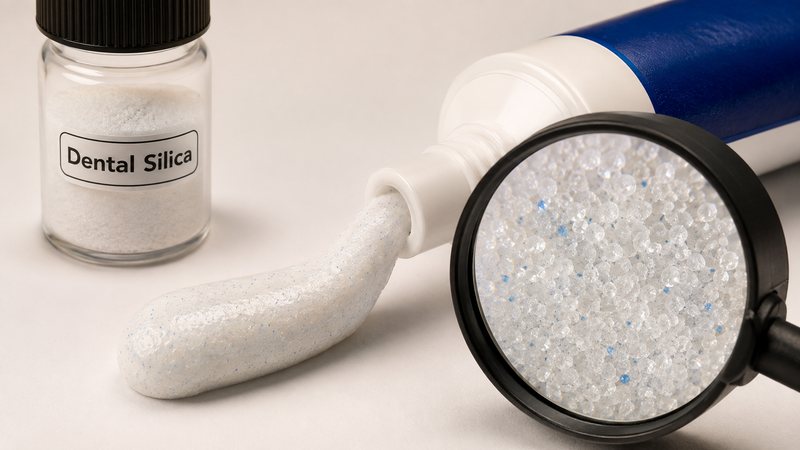
Two silica lines run through every dentifrice, and they answer to different specifications. The cleaning line — the low-surface-area route (BET by ISO 9277) — is judged on RDA and stain removal. The structuring line — the high-surface-area route — is judged on viscosity build, thixotropic recovery, extrusion force and what the tube looks like after ageing. Because a move on one line lands on the other, screen the two as a matrix.
The two lines answer to different specifications
Start from what the plant actually measures. On the cleaning line the tests are RDA under ISO 11609, stain removal and consumer grit; on the structuring line they are viscosity, yield stress, thixotropic recovery after shear, extrusion force from the tube, and whether the paste holds together through storage. Both lines are precipitated silica, but they are engineered toward opposite ends of the structure spectrum, and each ends up with its own acceptance criteria.
The physics behind that split is straightforward. A cleaning grade is compact and low in surface area, with a high tapped density, so each particle keeps the hardness and mass needed to lift pellicle from enamel. A structuring grade is open and highly branched, with a low tapped density, so it assembles a three-dimensional network in the aqueous phase and raises yield stress. Specify the two independently and cleaning can be adjusted without redesigning the gel.
Where the two lines run into each other
That independence has limits, and the limits are where development time disappears. Cleaning particles occupy volume in the continuous phase, so the paste thickens as their level rises even with the structuring grade untouched. Structuring silica pulls water into its pores, which changes how the cleaning fraction packs and settles. Surface area on both lines competes for humectant and for actives such as fluoride salts.
Storage stability is where the two lines collide most visibly. Viscosity that looks correct on day one but rests on too little yield stress lets the cleaning fraction sediment through shelf life; too much structure gives a paste that fights the extrusion test and can show syneresis or outright phase separation after temperature cycling. Since either line moves both viscosity and stability, a team that fixes cleaning first and rheology afterwards usually burns a second development cycle. A small screening matrix — cleaning levels against structuring levels — lands in one.
Cleaning line versus structuring line — the parameters that separate them
| Parameter | Method |
|---|---|
| BET specific surface area | ISO 9277 / DIN 66131 |
| Oil absorption (DBP) | ISO 4652 / DIN 53617 |
| Particle size D50 | ISO 13320 |
| Tapped density | ISO 697 |
| Bulk density (poured) | ISO 60 |
| pH (5% aq. suspension) | ISO 6588 |
| Sieve residue (45 µm) | ISO 2591-1 |
| SiO₂ content (dry basis) | Gravimetric / XRF |
Values. The figures for each property are on the grade's controlled TDS, which is sent with the sample; we do not publish typical-value tables on this site.
How we build the screening matrix
Write down the RDA band before anything else
The cleaning claim and its RDA window are the constraint everything else has to live inside, because they fix how much volume the cleaning fraction takes and how little room the structuring grade is left. Note that RDA belongs to the finished paste under ISO 11609 — no combination of raw-material figures predicts it.
Judge the cleaning line on size distribution, not surface area
What removes stain is particle size and the absence of a coarse tail. A controlled D50 with the 45 µm sieve residue held tight (ISO 2591-1) delivers the cleaning action while keeping out the oversize that produces RDA outliers and grit complaints from consumers.
Judge the structuring line on structure, not on how much you add
Yield stress is built by the network, so a high-surface, low-tapped-density grade hits the rheology target at a lower dose than any denser substitute. Dosing up a low-structure grade to compensate eats free water and leaves a paste that separates later.
Screen the two lines against each other in round one
Put at least two cleaning levels against two structuring levels in a single set of trials. Free water and particle packing tie the lines together, so a one-at-a-time sequence normally costs an extra development cycle to arrive at the same formulation.
Let ageing, not day-one viscosity, decide
Read extrusion force, yield stress, sedimentation and any sign of syneresis on temperature-cycled samples rather than fresh paste. Phase separation is an ageing phenomenon, and the initial viscosity number gives no warning of it.
Frequently asked questions
How do cleaning silica and structuring silica differ inside a toothpaste?
They sit at opposite ends of the structure scale. A cleaning grade is compact, low in surface area and high in tapped density, and does the mechanical work of lifting pellicle and stain. A structuring grade is open, highly branched and low in tapped density, and supplies the yield stress that keeps the paste standing and the actives suspended. A conventional dentifrice needs both on the bench.
Can one silica grade cover both cleaning and structure?
A few mid-structure grades cover part of each job, and formulators reach for them when a shorter ingredient list matters more than fine control. The cost arrives later: cleaning and rheology can no longer be tuned separately, so any new claim usually sends the formulation back to a two-grade design.
Why does the paste thicken when only the cleaning level is changed?
Solids take up room in the continuous phase and tie up free water, so the paste thickens as the cleaning fraction rises even though the structuring grade was never touched. That coupling is what makes one-factor-at-a-time trials misleading; move both levels together inside a screening matrix instead.
Related: Oral care solution overview · Full grade specifications · All articles